
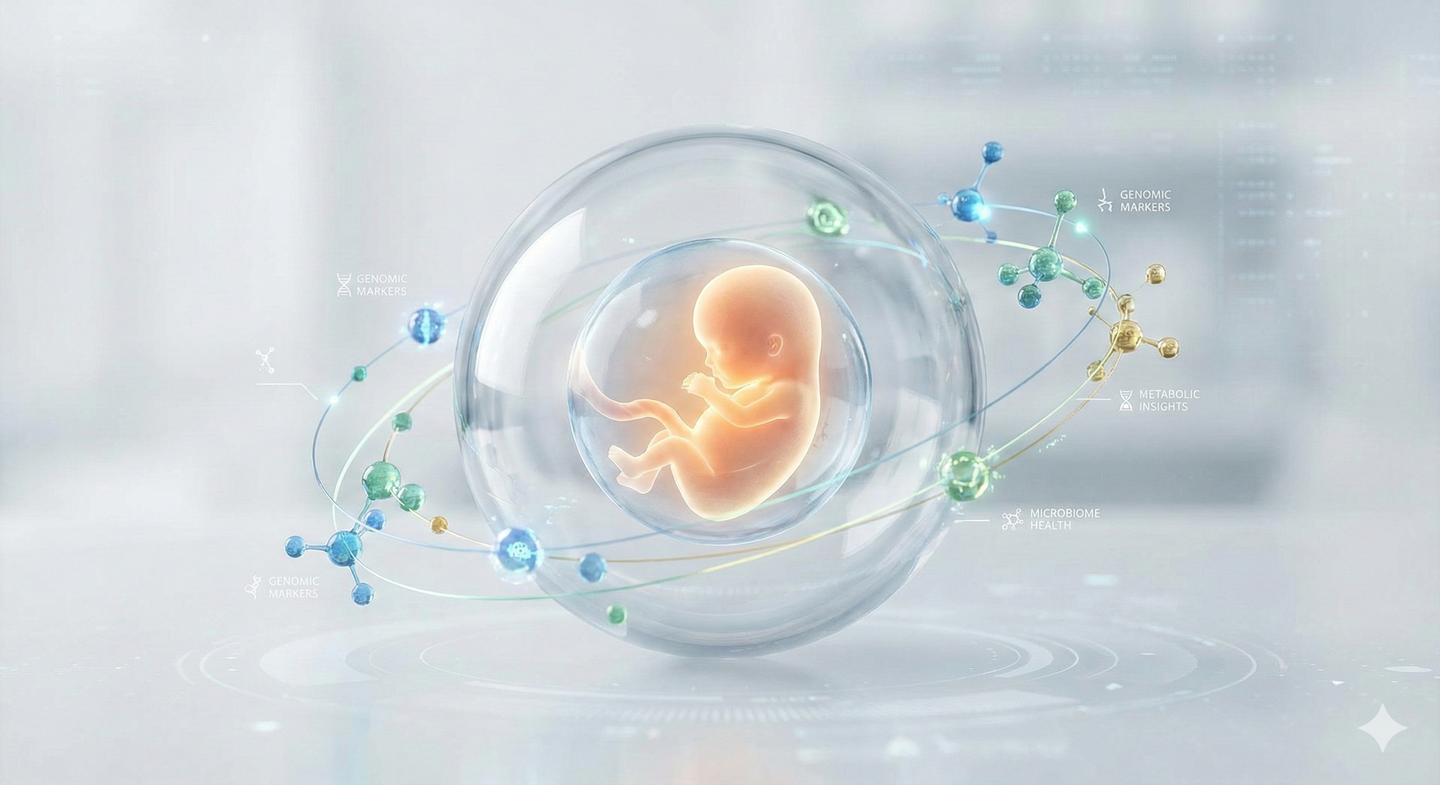
I often talk to couples who spend months meticulously planning a nursery, reading sleep-training books, and researching the safest car seats. Yet, when it comes to preparing the actual biological environment where that child will grow, the mother’s body, the standard medical advice is shockingly passive: "Stop taking birth control, start taking a prenatal vitamin, and come back in a year if you aren't pregnant."
This is reactive medicine at its worst.
Building a human being is arguably the most demanding physiological stress test a body will ever undergo. It requires massive nutrient reserves, precise endocrine signaling, and profound metabolic flexibility. Waiting for a year of failure before looking under the hood is an outdated paradigm. If we want to optimize for a healthy conception, a smooth pregnancy, and a resilient baby, we need to treat pre-conception and pregnancy with the same rigorous, data-driven biomarker tracking we apply to cardiovascular disease or athletic performance.
Here is the framework for optimizing your biochemistry from pre-conception through the third trimester, focusing on where "optimal" wildly differs from "standard lab normal."
Phase 1: Pre-Conception Optimization
The goal here is not simply asking, "Can you get pregnant?" We are asking, "Is your body a hospitable, nutrient-dense environment?" You want to test these markers 3 to 6 months before trying to conceive.
1. The Endocrine Baseline: Thyroid and Cycle Hormones Your thyroid controls the metabolic pace of every cell in your body, including your ovaries. In the first trimester, before the fetus develops its own thyroid gland, it is 100% reliant on the mother's thyroid hormone for neurological development [1].
- Thyroid Panel: You need a full panel (TSH, Free T3, Free T4, TPO Antibodies). The standard lab reference range for TSH goes up to 4.5 mIU/L. For conception and pregnancy, that is too high. You want a TSH < 2.5 mIU/L [1]. The presence of TPO antibodies should also be checked, as autoimmune thyroid issues can significantly impact implantation.
- Cycle Hormones (Day 3): Testing FSH, LH, and Estradiol on the third day of your cycle provides a baseline of ovarian function. You ideally want FSH < 10 mIU/mL and Estradiol < 50 pg/mL.
- Progesterone (Day 21): Testing Day 3 hormones tells you if the body is trying to grow an egg. Testing Progesterone ~7 days after ovulation tells you if you actually ovulated and if the uterine lining is thick enough to support a pregnancy. You want this > 10 ng/mL.
2. Ovarian Reserve vs. Egg Quality
- AMH (Anti-Müllerian Hormone): This is a highly useful proxy for your ovarian reserve (egg quantity). However, it is frequently misunderstood. A low AMH does not mean you have low egg quality, nor does it predict your ability to get pregnant this specific month [2]. It simply gives you a timeline for your fertility runway.
- Fasting Insulin: If AMH measures quantity, metabolic health is a massive driver of quality. Unmanaged insulin resistance (often seen in PCOS) creates an inflammatory environment that directly impairs egg quality and ovulation [3]. Your Fasting Insulin should be < 5 µU/mL.
3. The Nutrient Reserves You cannot build a placenta and a baby on empty stores.
- Ferritin (Iron Storage): This is where standard reference ranges completely fail women. Standard labs will flag a Ferritin of 15 ng/mL as "normal." That is borderline clinical depletion. To support the 50% expansion in blood volume required during pregnancy, you need optimal iron stores. Aim for a Ferritin > 50 ng/mL prior to conception [4].
- Vitamin D (25-OH): Critical for hormone production and implantation rates. Target 50 – 70 ng/mL.
- The Essentials: Ensure optimal levels of RBC Folate, B12, and an Omega-3 Index of > 8%. These are foundational for DNA replication and fetal neurodevelopment [5].
(A brief note on the male factor: Fertility is a 50/50 equation. A standard semen analysis is the baseline, but to truly assess the "seed," ask for a DNA Fragmentation Index (DFI). High fragmentation—anything > 15%—is a hidden driver of recurrent miscarriage and failure to conceive, even if standard sperm counts look normal.)
Phase 2: The First Trimester (Establishment)
Once conception occurs, the focus shifts to supporting rapid cellular division and the eventual handoff of hormone production to the placenta.
- hCG (Quantitative): In the first few weeks, you want to see this number actively doubling every 48 to 72 hours. A slow rise can be an early indicator of viability issues.
- Progesterone Maintenance: Progesterone must remain elevated to prevent the shedding of the uterine lining. If levels drop or hover below 10 ng/mL, supplementation is a standard and highly effective intervention discussed with an OB or Reproductive Endocrinologist.
- TSH Check: Because the metabolic demand increases drastically, your TSH should be re-checked in the first trimester to ensure it remains strictly < 2.5 mIU/L.
Phase 3: The Second and Third Trimesters (The Stress Test)
As the baby grows, the mother's body undergoes profound physiological adaptations. Normal pregnancy actually induces a state of temporary insulin resistance to ensure glucose remains in the bloodstream long enough to be shunted to the baby. We just have to ensure this doesn't tip over into pathology.
- Glucose Tolerance: The standard Oral Glucose Tolerance Test (OGTT) around 24–28 weeks screens for Gestational Diabetes. If you are borderline, or simply want to optimize, wearing a Continuous Glucose Monitor (CGM) for a few weeks is an incredible tool. It allows you to adjust your diet in real-time to keep post-meal glucose spikes ideally under 120-140 mg/dL.
- Hemoglobin & Ferritin: As your blood volume peaks in the third trimester, your red blood cells become diluted (hemodilution). Anemia is incredibly common here and poses a bleeding risk during delivery. Re-check Ferritin and Hemoglobin to ensure stores haven't crashed. Hemoglobin should remain > 11 g/dL [4].
- Blood Pressure & Urine Protein: These are standard clinical checks, but critical. Steadily creeping blood pressure (target < 120/80) alongside protein in the urine are the early warning signs of preeclampsia.
The Actionable Takeaway
You do not have to navigate the path to parenthood flying blind. The data is available. By shifting from a reactive "wait and see" approach to a proactive, biomarker-driven strategy, you can identify hidden roadblocks, optimize your internal environment, and give both yourself and your future child the highest possible physiological advantage.
Advocate for your labs, understand your optimal ranges, and treat your metabolic health as the ultimate prerequisite for pregnancy.If you want to learn more about the supplements that can help before and during pregnancy, check out the below article
 jake kaiser
Sources
[1] Alexander, E. K., et al. (2017). 2017 Guidelines of the American Thyroid Association for the Diagnosis and Management of Thyroid Disease During Pregnancy and the Postpartum. Thyroid, 27(3), 315–389. Link
[2] Steiner, A. Z., et al. (2017). Association Between Biomarkers of Ovarian Reserve and Infertility Among Older Women of Reproductive Age. JAMA, 318(14), 1367–1376. Link
[3] Broughton, D. E., & Moley, K. H. (2017). Obesity and female infertility: potential mediators of obesity's impact. Fertility and Sterility, 107(4), 840–847. Link
[4] Georgieff, M. K. (2020). Iron deficiency in pregnancy. American Journal of Obstetrics and Gynecology, 223(4), 516–524. Link
[5] Greenberg, J. A., et al. (2011). Folic Acid Supplementation and Pregnancy: More Than Just Neural Tube Defect Prevention. Reviews in Obstetrics and Gynecology, 4(2), 52–59. Link